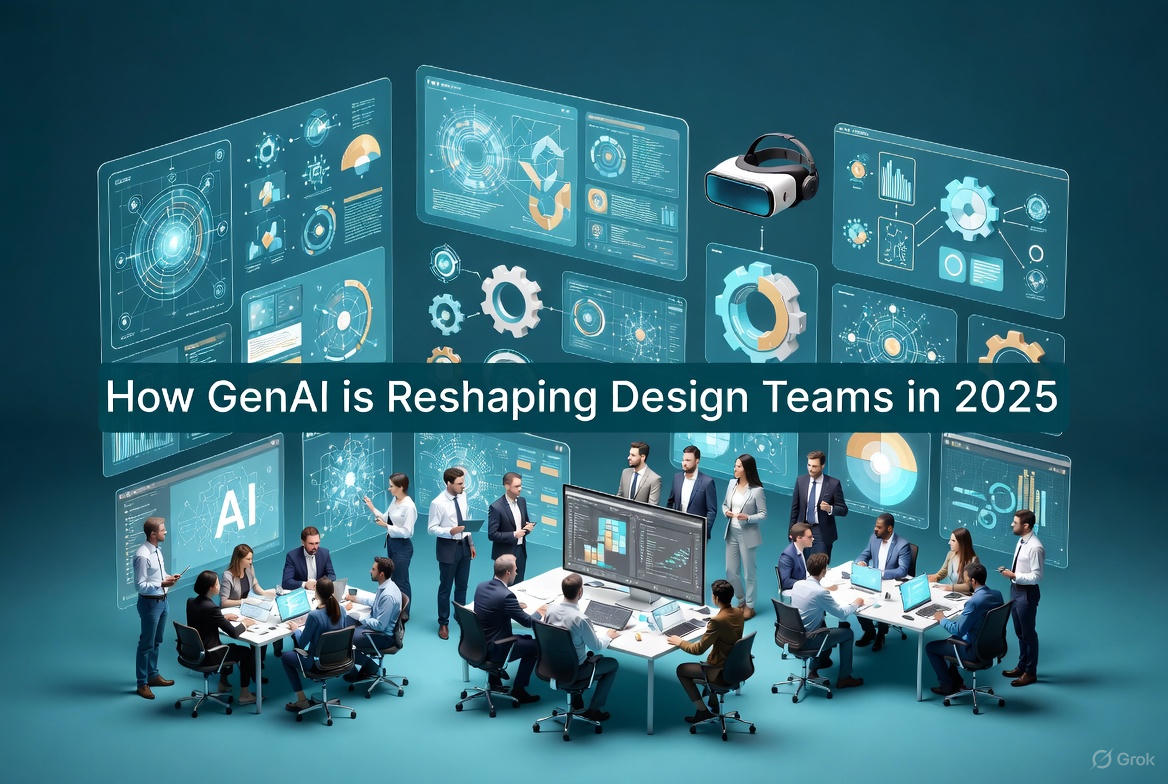
How GenAI is Reshaping Design Teams in 2025
IMAGINE THIS: It’s November 2025, and a Single senior designer quietly ships the entire visual and interaction system for a Series B consumer app in under six weeks—work that would have required a 12-person studio just two years ago. No late nights, no offshore production team, no endless revision rounds. Instead, she spends her days directing a silent orchestra of AI agents that research, sketch, prototype, test, and document faster than any human team ever could. What used to feel like science fiction is now Monday morning reality. Generative AI didn’t just give designers a new tool—it detonated the old org chart, rewrote career paths overnight, and forced every design leader to confront a single, urgent question: in a world where machines can create beautiful pixels at the speed of thought, what does it truly mean to be a designer anymore?

1. The Collapse of Traditional Ratios
The classic 1:6:1 unicorn ratio (1 designer : 6 engineers : 1 PM) is dead. Forward-leaning companies now operate closer to 1:12–18 with no loss in velocity or quality — because one designer augmented with GenAI can now cover the exploratory and production bandwidth of three 2022 designers.
What changed:
Ideation velocity increased 8–15× (from 12 concepts per week to 120+ with AI-assisted brainstorming and variation)
Visual and interaction prototyping time dropped from days to hours
Design system compliance checks that used to take a junior designer 20 hours now happen automatically
Handoff documentation writes itself in Figma + AI plugins
2. The New Design Roles That Didn’t Exist in 2023
Prompt Engineer → Systems Thinker: The best “prompt engineers” today are senior designers who understand mental models, not just syntax.
AI Orchestrator: A hybrid designer-developer who builds custom agents and RAG pipelines tailored to the company’s design language.
Synthetic User Researcher: Runs hundreds of simulated interviews and behavioral sessions using frontier models fine-tuned on past research.
Guardrail Designer: Specializes in ethical AI use, bias detection in generated outputs, and maintaining brand soul when 70% of pixels come from models.
Mid-level “make it pretty” roles have been the first casualty. Organizations that once hired armies of visual designers to execute known patterns now generate 90% of marketing assets, icons, illustrations, and layout variations automatically. The survivors are either exceptional craftspeople operating at senior level or those who pivoted into strategy, systems thinking, or AI orchestration.
The Rise of the T-Shaped+ Designer
4. The Rise of the T-Shaped+ Designer
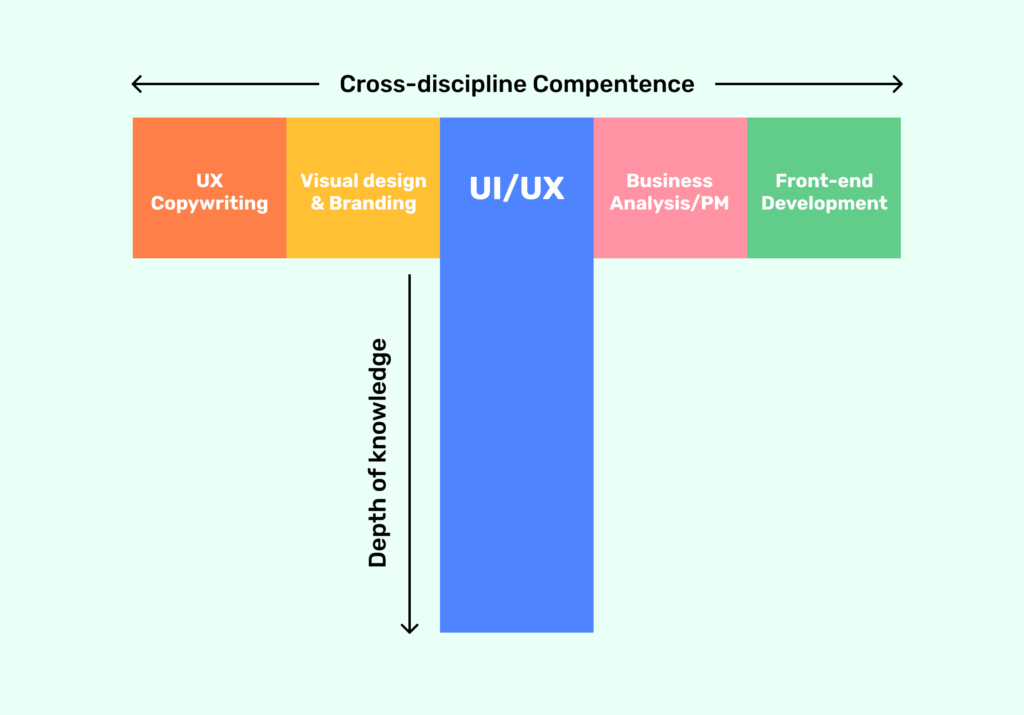
Depth in craft is no longer enough. The most valuable designers in 2025 combine:
Deep T vertical in either strategy, research, or interaction design
Broad base across prompt engineering, light code (especially front-end + AI scripts)
Systems thinking to manage fleets of specialized agents
5. New Team Structures Emerging
Three dominant patterns have appeared:
A. Pod + Agent Swarm
Traditional cross-functional squad (PM, engineers, 1–2 designers) + 6–12 specialized AI agents (research agent, copy agent, accessibility agent, etc.).
B. Center of Excellence Model
Small elite “Superhuman Design” team (6–10 seniors) that builds custom AI tools and agents used by hundreds of product designers.
C. Fully Synthetic Teams (experimental)
Startups shipping entire consumer apps with zero human designers on payroll — entirely AI-generated UI, continuously A/B tested and evolved by reinforcement learning agents. (Still rare, but growing.)
6. The Human Skills That Matter More Than Ever
Paradoxically, GenAI has made purely human abilities more valuable:
Taste and judgment: Deciding which of the 200 AI-generated options actually moves the needle
Empathy at scale: Understanding needs that synthetic users still can’t fully replicate
Storytelling and influence: Selling the chosen direction to leadership and engineers
Ethical foresight: Catching subtle bias, cultural insensitivity, or brand erosion that models miss
7. The Cultural Reckoning
The biggest friction isn’t technical — it’s emotional. Senior designers fear obsolescence. Juniors fear there’s no longer a ladder. Agencies that built empires on production hours are collapsing overnight.
Successful teams treat this like any other platform shift (phototypesetting → Mac, print → web, web → mobile). They invest heavily in upskilling, create clear new career frameworks, and are brutally transparent about what work is now automated and what remains deeply human.
Looking Ahead: 2026–2030
By 2030, we will likely look back at 2025 as the year “designer” stopped meaning someone who primarily moves pixels and started meaning someone who curates intelligence — directing ensembles of AI agents toward meaningful human outcomes.
The tools will keep advancing, but the core challenge remains unchanged since Bauhaus: how do we use whatever technology is available to create experiences that make people’s lives better?
Only now, the answer increasingly involves teaching machines to help us do it at superhuman scale — while fiercely protecting the parts only humans can do.
The design team isn’t shrinking. It’s evolving into something far more powerful.