The Ultimate Guide to Generative Engine Optimization (GEO) in 2025: Mastering AI-Driven Visibility
Published by abyss.singh on

The Ultimate Guide to Generative Engine Optimization (GEO) in 2025:
Mastering AI-Driven Visibility
“The fundamental premise of GEO is that success can be achieved even if a user never clicks through to a brand’s website” – Don Norman
In the ever-evolving digital landscape of 2025, where AI-powered search engines and chatbots dominate user interactions, traditional SEO is no longer enough to ensure your content cuts through the noise. Enter Generative Engine Optimization (GEO)—a strategic evolution designed to position your brand, content, and expertise directly within AI-generated responses. As platforms like ChatGPT, Google AI Overviews, Perplexity, and Claude reshape how information is discovered and consumed, GEO has become essential for marketers, content creators, and businesses aiming to maintain visibility in an AI-first world. This comprehensive guide dives deep into every aspect of GEO, from its foundational concepts and historical roots to advanced strategies, tools, metrics, challenges, and future trends. Whether you’re a beginner or an experienced SEO professional transitioning to AI optimization, we’ll cover it all in detail to help you dominate generative search results.
What is Generative Engine Optimization (GEO)?
Generative Engine Optimization (GEO) refers to the practice of optimizing digital content, websites, and brand presence to increase visibility and citations in AI-driven generative models and search engines. Unlike traditional search engines that return ranked lists of links, generative engines like ChatGPT, Perplexity, Google AI Overviews (formerly SGE), Bing Copilot (now part of Microsoft Copilot), and Claude provide synthesized, conversational answers by pulling from vast data sources. GEO ensures your content is not just discoverable but actively incorporated into these responses—through direct citations, summaries, quotes, or links.
The term GEO was popularized in a 2023 academic paper by Princeton researchers, which introduced it as a framework for improving content visibility in generative AI outputs. By 2025, GEO has expanded to encompass strategies tailored to Retrieval-Augmented Generation (RAG) systems, where AI models retrieve real-time web data to augment their responses. Key components include:
- Content Structuring: Formatting text for easy AI parsing, such as using clear headings, bullet points, statistics, and schema markup.
- Authority Building: Establishing E-E-A-T (Experience, Expertise, Authoritativeness, Trustworthiness) to make your content a preferred source.
- Multi-Platform Presence: Ensuring mentions across high-authority sites, social media, forums, and directories.
- AI-Specific Tactics: Incorporating elements like unique insights, quotations, and fluent language that AI models favor.
GEO is often used interchangeably with terms like Generative AI Optimization (GAIO) or Large Language Model Optimization (LLMO), but it specifically targets generative search experiences. For instance, LLMO focuses more on influencing foundational model training data, while GEO prioritizes real-time RAG integrations in search platforms.
Why GEO Matters in 2025
The rise of generative AI has fundamentally shifted user behavior and search dynamics. By mid-2025, AI-driven searches account for over 40% of all queries, with platforms like ChatGPT boasting 180 million monthly users and Perplexity seeing an 858% surge in search volume. Traditional organic traffic is declining—Gartner predicts a 50% drop by 2028 due to zero-click searches, where users get answers directly from AI summaries without visiting sites.
GEO matters because it directly impacts brand visibility, trust, and revenue. Benefits include:
- Increased Visibility: Optimized content can see 30-40% higher inclusion in AI responses, leading to broader reach without relying on clicks.
- Enhanced Credibility: Being cited by AI builds authority, as users trust generative responses more than traditional ads.
- Adaptation to User Trends: Searches are now conversational (average 13 words per query vs. 2-4 in traditional SEO), favoring detailed, intent-driven content.
- Competitive Edge: Early adopters gain a first-mover advantage in an emerging field, with smaller businesses potentially seeing up to 115% visibility gains.
- Multi-Channel Discovery: GEO aligns with “Search Everywhere Optimization,” ensuring presence across platforms like Reddit, YouTube, and LinkedIn.
GEO is often used interchangeably with terms like Generative AI Optimization (GAIO) or Large Language Model Optimization (LLMO), but it specifically targets generative search experiences. For instance, LLMO focuses more on influencing foundational model training data, while GEO prioritizes real-time RAG integrations in search platforms.
GEO vs. Traditional SEO: Key Differences
While GEO builds on SEO foundations, it diverges in focus, tactics, and metrics. Here’s a detailed comparison:
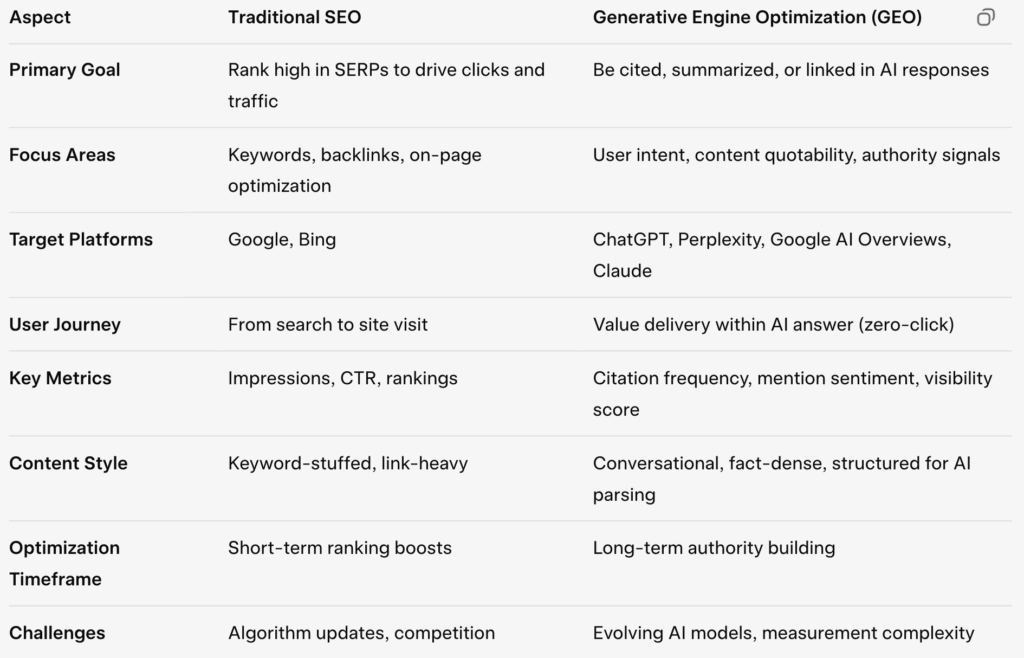
SEO remains vital for crawlability and backlinks, but GEO emphasizes machine-readable content and multi-platform mentions. For example, while SEO might optimize for “best running shoes,” GEO targets “recommend running shoes for marathon training in 2025” with expert quotes and stats.
How Generative Engines Work and Their Citation Patterns
Understanding generative engines is crucial for GEO. These systems use Large Language Models (LLMs) trained on massive datasets, enhanced by RAG for real-time data retrieval. Popular LLMs in 2025 include OpenAI’s o1 and GPT-4o, Google’s Gemini 2.0, Anthropic’s Claude 3.5 Sonnet, and Meta’s Llama 3.1.
Core Mechanisms:
- Query Processing: AI decodes intent, retrieves relevant data, and generates responses.
- RAG Integration: Combines internal knowledge with web searches (e.g., ChatGPT uses Bing, Perplexity uses Google).
- Citation Logic: AIs prioritize authoritative, fresh, and contextually relevant sources.
Citation Patterns by Major Platforms:
From extensive studies, citation behaviors vary:
- ChatGPT: Favors Wikipedia (48% of citations), Reddit (11%), and YouTube (11.3%). Produces long answers with ~10 references, often verbose. Relies heavily on Bing’s top 10 results (87% match).
- Google AI Overviews: Cites Reddit (21%), YouTube (19%), Quora, and LinkedIn. Averages 9.26 links, skewing toward older, established sites (half over 15 years old).
- Bing Copilot: Conservative with ~3 sources, favoring WikiHow (6.3%) for how-to content. Short answers (~400 characters), low YouTube use (<1%).
- Perplexity: Always provides 4-5 citations, dominated by Reddit (46.7%). Loves forums, UGC like Yelp and StackExchange. Surfaces long-tail, low-traffic content (45% of citations have negligible visitors).
These patterns highlight opportunities: High-authority lists and UGC boost citations, while niche content shines in Perplexity and ChatGPT.
Key GEO Strategies: A Deep Dive
Effective GEO requires a multifaceted approach. Based on leading guides and studies, here are proven strategies, categorized for clarity.
1. Build Authoritative and Factual Content
- Create comprehensive, multi-faceted articles addressing topics from various angles.
- Incorporate statistics, data visualizations, and original research to increase quotability (30-40% visibility boost).
- Use expert quotations and citations from trusted sources to enhance E-E-A-T.
2. Optimize Content Structure for AI Parsing
- Use clear headings, bullet points, and one idea per paragraph.
- Implement schema markup (e.g., FAQ, HowTo, Product) for better extractability.
- Write in fluent, declarative language with low perplexity—avoid jargon unless technical terms add value.
3. Secure Placements in High-Ranking Lists and Directories
- Aim for inclusion in top Google/Bing lists (e.g., “Best Tools of 2025”) via PR or paid placements.
- Get listed in directories like Wikipedia, Hoovers, or Bloomberg, which Claude favors.
- Publicize achievements (awards, customer stats) on your site and social media.
4. Leverage User-Generated Content and Social Proof
- Encourage positive reviews (aim for >3.5/5 stars) on platforms like Google, Yelp, and Trustpilot.
- Engage on Reddit, Quora, and StackExchange to build co-citations and mentions.
- Monitor social sentiment with tools like Hootsuite, as it’s increasingly factored in.
5. Multi-Platform Expansion and Co-Citations
- Publish on YouTube, LinkedIn, and forums for diverse citations.
- Build co-citations (mentions alongside competitors) through industry surveys and discussions.
- Use digital PR for advertorials and influencer collaborations to amplify mentions.
6. Target Conversational and Long-Tail Queries
- Analyze customer queries from support tickets and communities.
- Optimize for intent-driven prompts, appending modifiers like “2025” or “forums” for query fanout.
7. Technical Optimizations
- Ensure site crawlability by AI bots (no JavaScript blocks, fast loading).
- Use server-side rendering and HTTPS for accessibility.
Top performers in GEO studies show 30-40% improvements in metrics like Position-Adjusted Word Count.
Frameworks and Methods for GEO
Several frameworks guide GEO implementation:
PEECAI-SPA Framework
This 10-step approach focuses on:
- Prominence: Make content crawlable and prominent in sources.
- Engagement: Create interactive, unique content like 3D tours.
- Expertise: Target E-E-A-T topics.
- Consistency: Maintain uniform brand mentions.
- Accessibility: Use machine-readable formats.
- Influence: Leverage RAG over foundational models.
- Sources: Optimize for SEO and UGC.
- Prominence in Sources: Embrace social media.
- Actionable Content: Include pros/cons, reviews, and facts.
7-Step GEO Action Plan (Backlinko)
- Nail SEO basics.
- Build mentions and co-citations.
- Go multi-platform.
- Analyze AI citations in your niche.
- Answer audience questions.
- Structure content for AI.
- Track visibility.
Otterly.AI Methods
From their guide, top GEO methods include authoritative sourcing, unique insights, statistics, quotations, and fluent language, with 15-40% visibility gains.
Tools for GEO in 2025
Leverage these tools to streamline GEO:
- Otterly.AI: Monitors AI visibility, tracks citations, and suggests optimizations.
- Semrush AI SEO Toolkit: Analyzes sentiment, tracks mentions, and aids in query fanout.
- Ziptie.dev: Automates LLM visibility tracking.
- Writesonic: AI writing tool for GEO-optimized content creation.
- Peec AI: Identifies competitors and gaps for targeted actions.
- Hotjar/Heatmaps: Tests user intent for content refinement.
Others include Contently for content management and RightBlogger for strategy planning.
Case Studies and Examples
- Backlinko in ChatGPT: Mentioned for “how to build backlinks” due to YouTube videos and forum co-citations.
- Monday.com: Co-cited with competitors in project management queries via industry lists.
- Princeton Study: Tested GEO methods on 5,000 queries, showing 30-40% visibility improvements for statistics and quotes.
- Otterly.AI Research: Brands using fluent language and unique insights saw 15-30% gains in subjective win rates.
- Seer Interactive: Reported 40% traffic drops in industries hit by AI overviews, mitigated by GEO tactics.
These examples illustrate how niche, quotable content outperforms generic SEO-optimized pages.
Metrics and Measurement in GEO
Traditional metrics like CTR fall short; focus on:
- Position-Adjusted Word Count: Measures prominence in AI responses (higher = better).
- Citation Frequency: Number of mentions across AI platforms.
- Subjective Win Rate: Human-evaluated relevance and appeal.
- Visibility Score: Tools like Otterly.AI track this via automated queries.
- Mention Sentiment: Positive vs. negative context.
Use manual testing (varying prompts) and tools for ongoing monitoring.
Challenges and Best Practices
Challenges include:
- Evolving AI algorithms requiring constant adaptation.
- Measurement difficulties without specialized tools.
- Over-reliance on UGC platforms with moderation risks.
- Learning curve for non-technical teams.
Best Practices:
- Start with SEO audits and E-E-A-T enhancements.
- Experiment with small-scale tests (e.g., add stats to one page).
- Combine GEO with SEO for hybrid success.
- Stay compliant with AI regulations (e.g., EU AI Act).
- Invest in long-term PR for sustainable mentions.
The Future of GEO
By 2030, GEO could merge with SEO as AI agents handle 23% of searches. Expect multimodal optimization (video, images) and personalized responses. Challenges like bias and transparency will drive ethical GEO, with tools evolving for real-time insights. Businesses ignoring GEO risk invisibility, while adopters will lead in an AI-dominated ecosystem.
Conclusion
Generative Engine Optimization is the key to thriving in 2025’s AI search era. By mastering strategies, tools, and metrics outlined here, you can ensure your content isn’t just seen but trusted and cited by the world’s leading AIs. Start small, measure relentlessly, and adapt— the future of search is generative, and GEO is your roadmap to success. What are your GEO experiences? Share in the comments!
#GenerativeEngineOptimization, #GEO2025, #AISEO, #ChatGPTOptimization, #PerplexityAI, #GoogleAIOverviews, #AIContentStrategy, #LLMO, #SearchEverywhere, #DigitalMarketingTrends, #AIVisibility, #ContentOptimization, #EATPrinciples, #AICitations, #FutureOfSearch